

External Issues Affecting Your Mining Operations Plan
The operational costs of your mining operations are affected by a number of external pressures, including market volatility and regulatory factors. According to KPMG’s 2018 Insights into Mining survey, commodity price was identified as the number-one risk by mining industry executives.The Top 5 Risks Identified by Mining Executives
 The prices of commodities (including mineral ores) are determined by macroeconomic factors, but they directly impact your revenue (by setting the price of your ore). If those prices decline, you will need to know what you can do to your mine to sustainably throttle operations.
Commodity Price Index (2010=100; real US$2005) for Precious Metals, Metals and Minerals
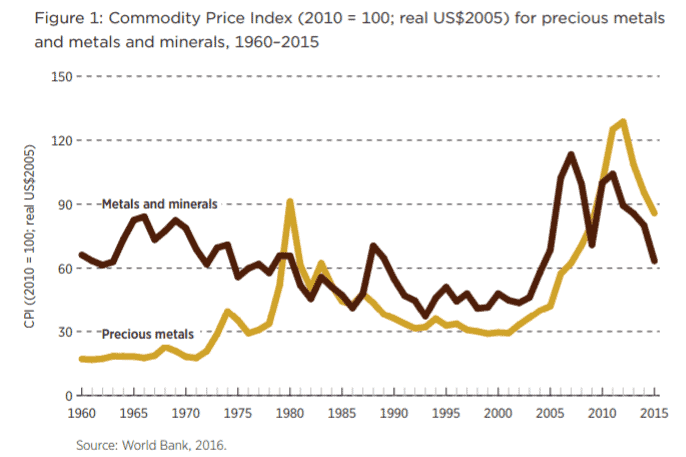 Commodity prices had peaked in 2010-2012, but dropped sharply in subsequent years, causing a sharp decline in revenue for mining operations all over the world. The decline has also caused - and left - investor and financing hesitance in expanding mining operations.
The second-highest area of risk - i.e. the risk of delay in gaining mining exploration permits - is a regulatory factor that affects discovering and mining new ore deposits, i.e. your opportunities for expanding your revenue base, especially for the long-term.
Commodity prices had peaked in 2010-2012, but dropped sharply in subsequent years, causing a sharp decline in revenue for mining operations all over the world. The decline has also caused - and left - investor and financing hesitance in expanding mining operations.
The second-highest area of risk - i.e. the risk of delay in gaining mining exploration permits - is a regulatory factor that affects discovering and mining new ore deposits, i.e. your opportunities for expanding your revenue base, especially for the long-term.
Changes in the Time to Permit Approval Between 2005 and 2015
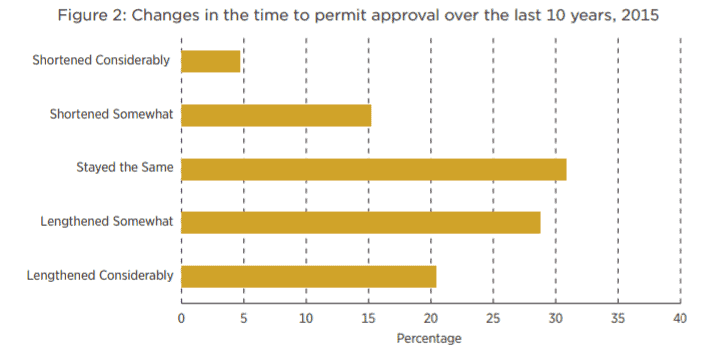 According to a survey of 2,700 global mining executives and managers by the Fraser Institute, 50% of respondents “indicated that the time for permit approval has increased from ten years ago and 20% indicated that the time has lengthened considerably.”
Successfully navigating through these risks requires possessing strong insights of your mining operations. These insights will help you identify what factors are fuelling your costs, managing your equipment usage and securing stakeholder buy-in.
According to a survey of 2,700 global mining executives and managers by the Fraser Institute, 50% of respondents “indicated that the time for permit approval has increased from ten years ago and 20% indicated that the time has lengthened considerably.”
Successfully navigating through these risks requires possessing strong insights of your mining operations. These insights will help you identify what factors are fuelling your costs, managing your equipment usage and securing stakeholder buy-in.
The Essential Operational Insights of Your Mine
With the aforementioned factors in mind, the following areas are the most important operational insights you must have on your mining operations.Identify Your Bottlenecks
You must identify the system bottlenecks of your mining operations. These are the inefficiencies in your mining operations - e.g. a specific process, certain equipment or poor mine design - that are preventing the mine from reaching its output potential. However, it’s important that you not mistake a short-term constraint for a system bottleneck. For example, a broken or out-of-service machinery will certainly delay your output, but it may not be the bottleneck that is responsible for long-term loss of revenue. Correctly identifying the system-level bottleneck will enable you to begin rectifying it by pushing the constraint to the area requiring the highest amount of investment. Rectifying that constraint would mean improving the most significant subsystem of the mine, thus maximizing returns.Understand Your “Main Levers to Pull”
As discussed above, your mining operation can be affected by a range of external factors, many that are largely out of you and the mining industry’s control. From price volatility or friction in the regulatory space (denying mining exploration permits), you need to know how you can promptly adjust your mines’ operations to align with current realities. For example, in response to a decline in commodity pricing affecting ores, you should have an insight into how you can throttle or reduce ore output from your mines, especially in regards to existing equipment and processes.Cost Optimization Opportunities
Due to shareholder pressure, limited access to credit, financing for new equipment or external factors (e.g. commodity price volatility), you may be required to optimize your resources. This requires lowering the availability of certain equipment, especially those wherein reduced availability does not affect your mineral ore recovery output. The idea is to reduce the cost of mining without reducing the results of your mining operations.MOSIMTEC’s Resource Optimization Consulting Offers an Average 10X ROI